Showing posts with label Astro. Show all posts

Wednesday, November 5, 2025

Big Sur: Boronda Trail to Timber Top Camp (2025)

Dates: October 18-19, 2025

I was itching to get back outside for a quick backpacking trip, and with the Sierras getting colder I looked closer to the coast. I’ve had my eye on this Timber Top campsite for a while now for the views, and the weather this past weekend looked perfect. I left the Bay Area around noon on Saturday and was also back on Sunday by noon.

I carried up 4.5L of water since the campsite is dry, but after I came back with over a liter left I would have been fine with 3.5L. Always better to have more and I could have used some to lightly wash up at the top. There is apparently a spring just past halfway up on the trail on a branch off to the left (north) along Lafler creek that you could refill water from. I saw the branch off point but did not go investigate.

Day 1: Boronda Trailhead to Timber Top (3 miles, +2,500 ft elevation gain)

I wanted to get up camp before sunset, so I started driving down to the Boronda trailhead just past noon and got there around 3PM. Even the drive down was more beautiful than I expected; I fully understand why people drive Highway 1 now. I’ve only ever gone down to Point Lobos in the last several years and don’t remember the last time I’ve gone farther. The weather was truly perfect; the skies were cloudless but I had the clouds of the marine layer below me.

Parking was easy; there was plenty of room along the side of the road for the approximately 7 cars parked at the trailhead. I pretty much did not stop hiking on the way up (except for the occasional photo) and passed a few groups that were doing the same trip. The views of the ocean were incredible, but the uphill grind was non-stop all the way to the top. There were a few short sections that were slightly flat and shaded that I greatly appreciated; my calves felt stretched the entire time on the steep ridge trail.

Peak chair placement at the home near the trailhead.


I got to Timber Top camp proper in about 1.5hrs, and then headed a little past it to find an open campsite on the ridges that had an unobstructed view of the ocean. There was a chain of three sites branching off of the main ridge, and I settled down on the middle one.

Hachiware on another great adventure.

I did a little painting (I really need to sit down and practice painting foliage more, and just slow down in general) before setting up my camp and getting settled for the sunset. There was just a slight breeze that fully died down some time in the middle of the night. Definitely a top ten sunset that I’ve ever seen; there’s something just magical about being above a cloud layer and seeing the shadows of the clouds get deeper and deeper as the sun sets. As it got to true darkness, I did a little stargazing before heading to sleep.


Day 2: Timber Top to Boronda Trailhead (3 miles, 2,500 ft elevation loss)

Just like the sunset, I woke up to a similarly incredible sunrise above the clouds of the marine  layer. I had a very restful sleep, unlike some of my other nights out in the wilderness this year, and was able to enjoy the morning while drinking some miso soup for breakfast. I took some more photos before packing up and heading back. It was a perfect weekend getaway, with plenty of time for the rest of the day to get other things done.

Waking up.

Sunrise.

Another group descending below me.


Wednesday, August 13, 2025

Thousand Island Lake Backpacking (2025)

Dates: August 2-3, 2025

I recently took a few friends on their first ever backpacking trip to Thousand Island Lake, having heard so much about the lake and the views there.

We took the River Trail directly to the lake from Agnew Meadows, and returned the second day via the JMT passing Emerald, Ruby, and Garnet Lake before taking the Garnet Lake cutoff back to the river trail (didn’t get around to visiting Shadow Lake unfortunately). We had fair weather the entire weekend, without a single cloud in the sky.

Day 1: Agnew Meadows to Thousand Island Lake via River Trail (9 miles, +2000 ft elevation gain)

We had to take the shuttle from the Mammoth Adventure center to the first stop, Agnew Meadows. The shuttle is very convenient to take on the way in; just buy a ticket at the Adventure center and get on the shuttle, which runs every 20 minutes for most of the day during the weekends.

Water sources were readily available along the River Trail and we didn’t need to carry more than a liter at a time. The elevation gain was pretty well distributed along the whole distance, and there was no part that was significantly difficult. The trail was a little sandy for the first few miles, which was a little annoying to walk along since each step kicked up a good amount of dust. We had regular breaks along the trail, taking in the sights and eating our snacks. When we finally crested the hill and turned toward the outlet of the Thousand Island Lake, we were greeted with the view of Banner Peak rising into view over the trees. It took us some time to find a good place to camp along the shore since we didn’t want to be too far from the water and many places were marked for restoration. There were a decent number of people camped here for the night, which is not surprising given its popularity and intersection with the JMT and PCT. (Turns out more sandy sites were higher up along the shore than I expected.) For dinner, we brought along burritos that we bought in Mammoth right before we got on the shuttle. Not the greatest burrito in the world, but it was still slightly warm and delicious after a long hike.


Approaching the lake.

The view of Banner Peak and the Thousand Island Lake exceeded my expectations. The changing sunlight during sunset and sunrise created a beautiful warm glow on the peak that faded into the night; however, the night was not any more incredible under the light of the stars and moon. I woke up several times at night to capture photos of the Milky Way rising over Banner Peak, reflected in the still water of the night. It was nearly silent after the wind died down past sunset, with only the occasional blip of noise from nearby animals.

Perfect reflection.

Monday, July 20, 2020

Comet C/2020 Astrophotography

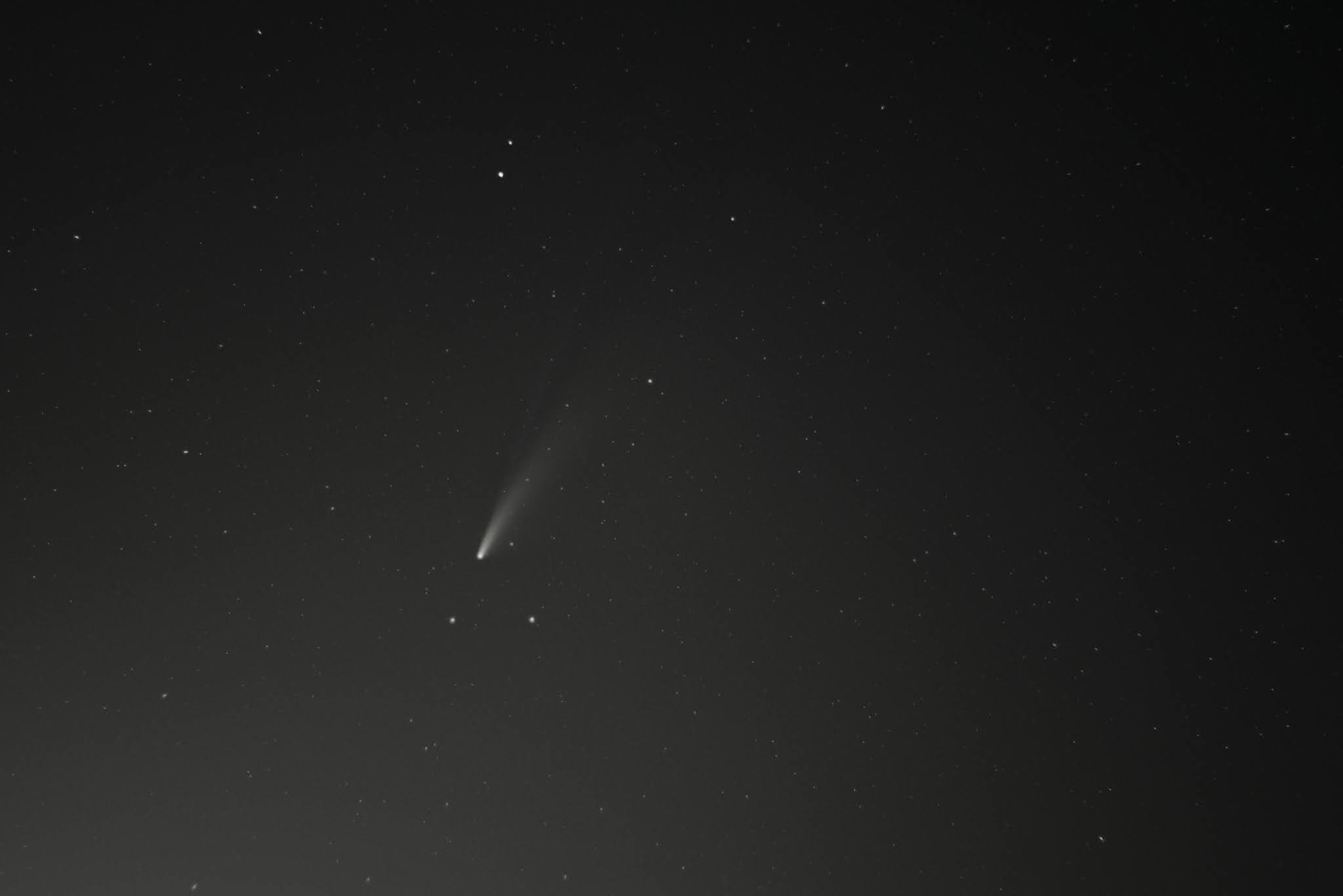
Last weekend I went out to take some photos of the comet C/2020 F3 NEOWISE, which is has been passing by for the last several days and will still be in sight for a few more days. I wasn't able to go too far to get to a dark place so the light pollution was pretty bad. Not the most detail in the photos but some stacking and light pollution gradient removal worked pretty well.

I haven't done astrophotography for awhile so I was a little rusty, but still got some nice shots:

135mm, f/5.6, 2 seconds, 80 lights stacked in DSS, gradient removed in PS.

50mm, f/1.8, ISO 800, 4 seconds, 55 lights stacked in DSS, gradient removed in PS.
Panorama.


Saturday, November 26, 2016

Return of the Barn Door Tracker

After last time's rather lackluster tracking, I decided to try out the barn door tracker again. I used essentially the same hardware as before, but greatly simplified the electronics. I added another 1:3 gear reduction stage so the final ratio was 1:15, allowing me to run the drive motor faster. Instead of having closed loop feedback with the PID like before, I just used a cheap buck-boost converter from eBay to provide a constant voltage that should keep the motor turning at a fairly constant rate.

I adjusted the voltage so that the final gear rotated at one revolution per minute. Power came from a small LiFePo4 battery.
Battery, buck-boost, and LEGO gears.
With this much simpler setup, I was able to mount everything to the tracker so that when it was running I didn't have to any physical contact with it, which could introduce vibrations.

I took the setup for a spin in my front yard. This time I was able to do a somewhat proper polar alignment since Polaris was actually visible. After a bit of eyeballing, I decided the hinge was close enough in line. I tested taking photos with and the tracker on and off, and after a bit of fiddling, sure enough, the tracker was working. Sure, the stars weren't nice pinpoints, but the trails were significantly reduced.

Tracking off. 135mm f/5.6 20" ISO 400
Tracking on. 135mm f/5.6 20" ISO 400


Finally!

However, the setup was not without its flaws. The whole thing lacked any rigidity, so after handling the hinge I had to wait about five seconds for the whole thing to stop wobbling before taking a photo.

I initially had the drive direction close the hinge over time, but the threads would get stuck in the hole in the wood and the hinge wouldn't close. I swapped the polarity on the motor to drive the hinge open since this would guarantee that the hinge has to move.

There is also periodic error in the drive mechanism. Looking at the movement of the stars in each photo, it's clear the hinge is moving very slightly in axes other than the polar axis. The movement repeats itself every minute (the drive gear turns once per minute hm...), leading me to think that the main drive gear is not concentric with the threaded rod. I did just eyeball the position of the nut and hole on the main gear so it's no surprise.
Wobble wobble.
I tried to do some imaging of the Orion nebula, but only a few frames didn't have any extreme streaking. I stacked the twelve "usable" frames, did some basic editing in Photoshop and got this:
135mm f/5.6 12x10" ISO 800 (and 21 darks)
To improve the setup, I would likely need a much more rigid hinge that wouldn't allow any movement other than opening and closing, so any other wobbling movement from the threaded rod wouldn't be able to actually affect the setup. I also need a better tripod so any movement from the wind is minimized.

Sunday, November 13, 2016

Supermoon

Tomorrow is supposed to be a supermoon, and thought it would be nice to get a photo of it. I don't have any fancy equipment, but a handheld shot is perfectly fine because of how bright the moon is. Also, the moon is quite big so an ordinary telephoto lens will do.

Let's have a go:

Pretty normal.

Saturday, June 11, 2016

Barn Door Tracker

I don't think a barn door tracker works this way.
In an attempt to get longer exposures of deep space objects, I decided to build a barn door tracker. This would help track the stars so there is no trailing created by the rotation of the earth, The general concept behind the tracker is that the camera is mounted on a hinge, and the axis of the hinge is pointed toward the celestial pole (the apparent axis of rotation for the earth; it's near the star Polaris in the norther hemispehere). The hinge would rotate at the same rate as the earth, so to the camera the stars appear to be fixed in place. About a month ago I tried making a hand-cranked one, but there many severe problems with it. I didn't have a second ball head, so I couldn't aim the camera, and the setup lacked any rigidity, so any attempt to compensate for the rotation of the earth was negated by the wobble created by my hand. Not to mention I didn't have a real way to properly align with the celestial pole.

Monday, August 24, 2015

The End of Summer

Well, summer break is coming to an end and the beginning of 11th grade is fast approaching. I did have some fun, even with all the SAT prep.

Just over a week ago I went to Fremont Peak State Park at San Juan Bautista, CA to do some astrophotography because the light pollution there is far lower than in the city.


A panorama of the Milky Way.

I also went to Hawaii.
Napali Coast
Waimea Canyon